




7 Critical Reasons Why Quantity Verification Improves Rebar Estimation
Every successful construction project begins with accurate planning. Structural engineers carefully develop reinforcement designs, estimators prepare quantity take-offs, procurement teams source materials, and contractors coordinate execution. Yet, despite the sophistication of modern construction workflows, one critical process is often overlooked—Quantity Verification in Rebar Estimation.
Many professionals assume that once reinforcement quantities have been calculated, the estimation is complete. In reality, preparing an estimate and verifying it are two very different processes. An estimate without proper verification introduces uncertainty into procurement, budgeting, fabrication, and project scheduling.
Even a small quantity discrepancy can multiply across a large construction project, leading to material shortages, excess procurement, project delays, and unnecessary financial losses.
Professional quantity verification transforms estimation from a numerical exercise into a dependable decision-making tool. It gives contractors, developers, consultants, and procurement teams the confidence that every reinforcement quantity has been reviewed before purchasing begins.
👉 Explore our
Rebar Detailing Services
https://kryptosrebar.com/kryptos-rebar-detailing-and-estimation-services/
What Is Quantity Verification in Rebar Estimation?
A Critical Quality Assurance Process
Quantity Verification in Rebar Estimation is the systematic review of reinforcement quantities before they are released for procurement or fabrication.
Its purpose is to ensure that estimated quantities accurately represent the latest approved structural drawings and project requirements.
A professional verification process typically reviews:
1.Structural drawings
2.Reinforcement layouts
3.Quantity take-offs
4.Steel weight summaries
5.Development lengths
6.Lap splice calculations
7.Bar Bending Schedule (BBS)
8.Structural revisions
Rather than checking only the final total, verification confirms that every reinforcement bar has been considered correctly.
This process significantly reduces project risks before procurement begins.
Why Quantity Verification Is Frequently Overlooked
The Pressure of Fast Project Delivery
Construction projects operate under tight deadlines.
Tender submissions, procurement schedules, and client expectations often require estimators to deliver quantities quickly.
Because of these pressures, many organizations unintentionally treat quantity verification as optional.
Common reasons include:
1.Aggressive project schedules
2.Limited estimation resources
3.Overconfidence in software outputs
4.Frequent drawing revisions
5.Insufficient quality assurance procedures
While skipping verification may appear to save time initially, it often creates far greater problems later during procurement and construction.
The Difference Between Estimation and Verification
Calculating vs Confirming
Estimation answers the question:
“How much reinforcement does this project require?”
Verification answers a more important question:
“Are we certain these quantities are correct?”
Without verification, estimators cannot confidently answer:
1.Were all structural elements included?
2.Were the latest drawings used?
3.Were lap lengths calculated correctly?
4.Has every revision been incorporated?
5.Does the Bar Bending Schedule match the quantity report?
Verification transforms estimation into reliable project information.
How Quantity Verification Improves Procurement
Procurement Depends on Accurate Information
Every procurement decision relies on estimated quantities.
Procurement teams determine:
1.Purchase quantities
2.Supplier requirements
3.Delivery schedules
4.Inventory planning
5.Budget allocations
If quantities are inaccurate, procurement immediately becomes vulnerable.
Underestimated Quantities
Underestimation often causes:
1.Emergency purchases
2.Project delays
3.Increased steel costs
4.Fabrication interruptions
Overestimated Quantities
Overestimation leads to:
1.Excess inventory
2.Higher storage costs
3.Capital tied up in unused steel
4.Increased handling expenses
Professional Quantity Verification in Rebar Estimation minimizes both risks by ensuring procurement decisions are based on reliable information.
Supporting Better Cost Control
Quantity Accuracy Protects Project Budgets
Reinforcement steel represents one of the largest material costs in reinforced concrete construction.
Even a small percentage error can significantly affect project budgets.
Verified quantities improve:
1.Budget forecasting
2.Procurement planning
3.Cost monitoring
4.Material optimization
5.Financial reporting
Accurate quantity verification helps project teams maintain tighter control over construction costs while reducing unexpected expenses.
Reducing Material Waste
Every Kilogram Counts
Material waste directly reduces project profitability.
Common causes include:
1.Duplicate quantities
2.Incorrect lap calculations
3.Missed structural revisions
4.Procurement errors
5.Fabrication mistakes
Quantity verification identifies these issues before steel is ordered.
This supports:
1.Better material utilization
2.Lower waste generation
3.Improved sustainability
4.Increased profitability
Improving Fabrication Accuracy
Better Quantities Lead to Better Fabrication
Fabricators rely on accurate quantity reports and Bar Bending Schedules.
Incorrect quantities often create:
1.Wrong bar lengths
2.Incorrect fabrication quantities
3.Production delays
4.Scrap material
Professional verification ensures fabrication information matches approved structural requirements.
This improves production efficiency while reducing costly fabrication errors.
Bar Bending Schedule Verification
Why BBS Must Always Be Reviewed
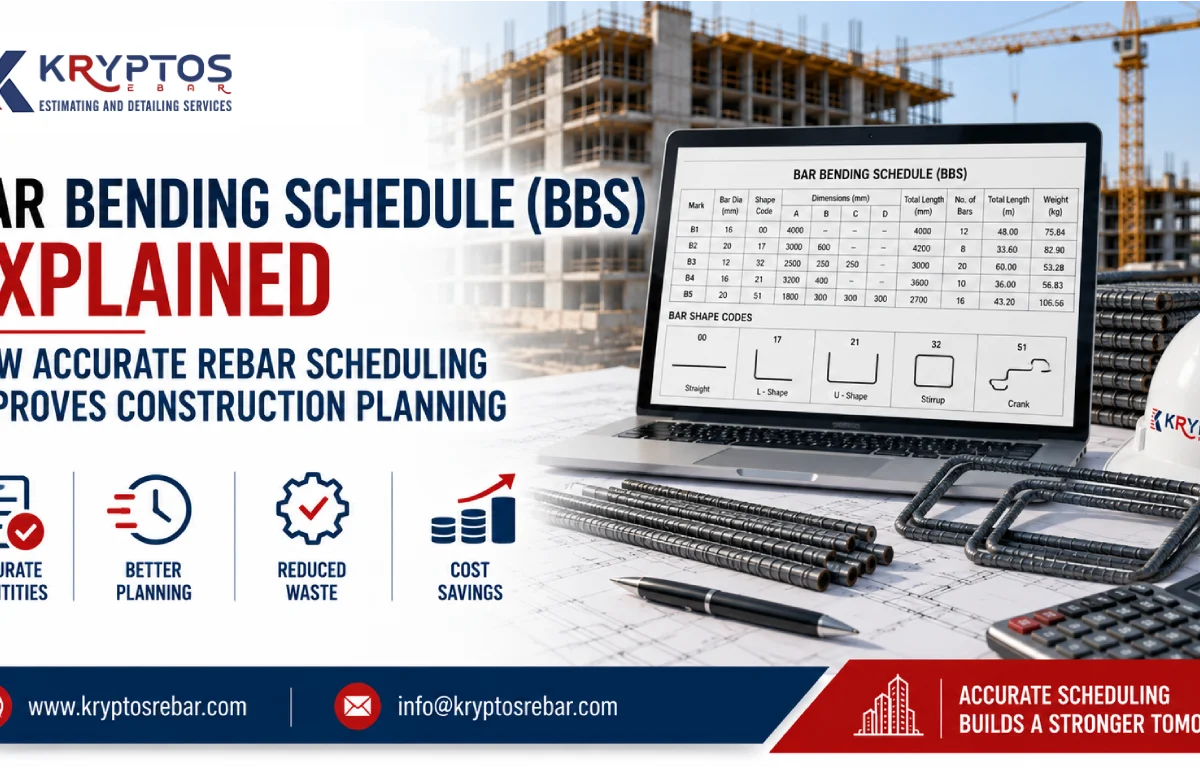
The Bar Bending Schedule (BBS) converts reinforcement information into fabrication-ready instructions.
Every revision affecting reinforcement should also update:
1.Bar marks
2.Bar lengths
3.Steel weights
4.Quantities
Failure to verify the BBS can create procurement discrepancies and fabrication errors.
👉 Outbound Link: BSI Group BS 8666 Reinforcement Scheduling Standard
Technology Improves but Does Not Replace Verification
Software Supports Accuracy
Modern estimation software has transformed quantity take-offs.
Industry-standard tools include:
1.AutoCAD
2.RebarCAD
3.Bluebeam
4.ASA
5.Tekla Structures
These platforms improve productivity and consistency.
However, software calculates only the information entered into the model.
Professional engineering review remains essential to confirm:
1.Structural completeness
2.Quantity accuracy
3.Drawing revisions
4.Reinforcement assumptions
Technology supports quantity verification—it does not replace it.
👉 Tekla Structures
https://www.tekla.com/products/tekla-structures
Digital workflows reduce manual errors and improve procurement planning.
Common Quantity Verification Mistakes
Errors That Affect Entire Projects
Several common mistakes continue to impact construction projects.
These include:
❌ Using Outdated Structural Drawings
Revisions may significantly change reinforcement quantities.
❌ Missing Structural Elements
Incomplete reviews create procurement shortages.
❌ Incorrect Lap Length Calculations
Minor calculation errors accumulate across projects.
❌ Skipping Independent Reviews
A second review often identifies hidden discrepancies.
❌ Releasing Estimates Without QA
Quality assurance should never be optional.
Avoiding these mistakes significantly improves project outcomes.
Best Practices for Quantity Verification in Rebar Estimation
Building a Reliable Verification Process
Construction organizations should establish structured verification procedures.
Recommended best practices include:
✔ Review the latest approved drawings.
✔ Verify reinforcement quantities element by element.
✔ Cross-check quantity reports with Bar Bending Schedules.
✔ Confirm development lengths and lap calculations.
✔ Review every structural revision before finalizing quantities.
✔ Perform independent quality assurance reviews.
✔ Maintain revision tracking throughout the project.
✔ Coordinate estimation with detailing and procurement teams.
These practices improve estimation accuracy while reducing downstream project risks.
Business Benefits of Quantity Verification
More Than an Engineering Task
Professional Quantity Verification in Rebar Estimation provides measurable business value.
Benefits include:
Better Procurement Planning
Accurate quantities support smarter purchasing decisions.
Improved Cost Control
Reliable estimates reduce financial uncertainty.
Reduced Material Waste
Better planning minimizes unnecessary steel consumption.
Improved Project Scheduling
Material availability aligns with construction progress.
Increased Client Confidence
Verified estimates strengthen trust and project credibility.
Higher Profitability
Fewer procurement errors improve financial performance.
How Kryptos Rebar Ensures Estimation Accuracy
Quality Built Into Every Estimate
At Kryptos Rebar, quantity verification is embedded within every estimation workflow.
Our structured process includes:
1.Independent quantity reviews
2.Drawing revision management
3.BBS verification
4.Procurement-focused reporting
5.Multi-level quality assurance
This disciplined approach helps clients reduce procurement risks while improving project efficiency and cost control.
Conclusion
Quantity Verification in Rebar Estimation is often viewed as a final review step.
In reality, it is one of the most valuable quality assurance processes in modern construction.
Accurate verification protects:
1.Procurement planning
2.Material quantities
3.Project budgets
4.Construction schedules
5.Fabrication accuracy
6.Overall project profitability
Projects that prioritize quantity verification experience fewer surprises, stronger financial performance, and smoother execution.
As construction projects continue to grow in complexity, verification is no longer optional—it is an essential component of professional rebar estimation.
🚀 Need Accurate Rebar Estimation You Can Trust?
Connect with Kryptos Rebar for precision-driven rebar detailing, estimation, and constructability-focused reinforcement solutions.
📩 Email now: [email protected]
Let’s optimize your structure with precision and confidence.