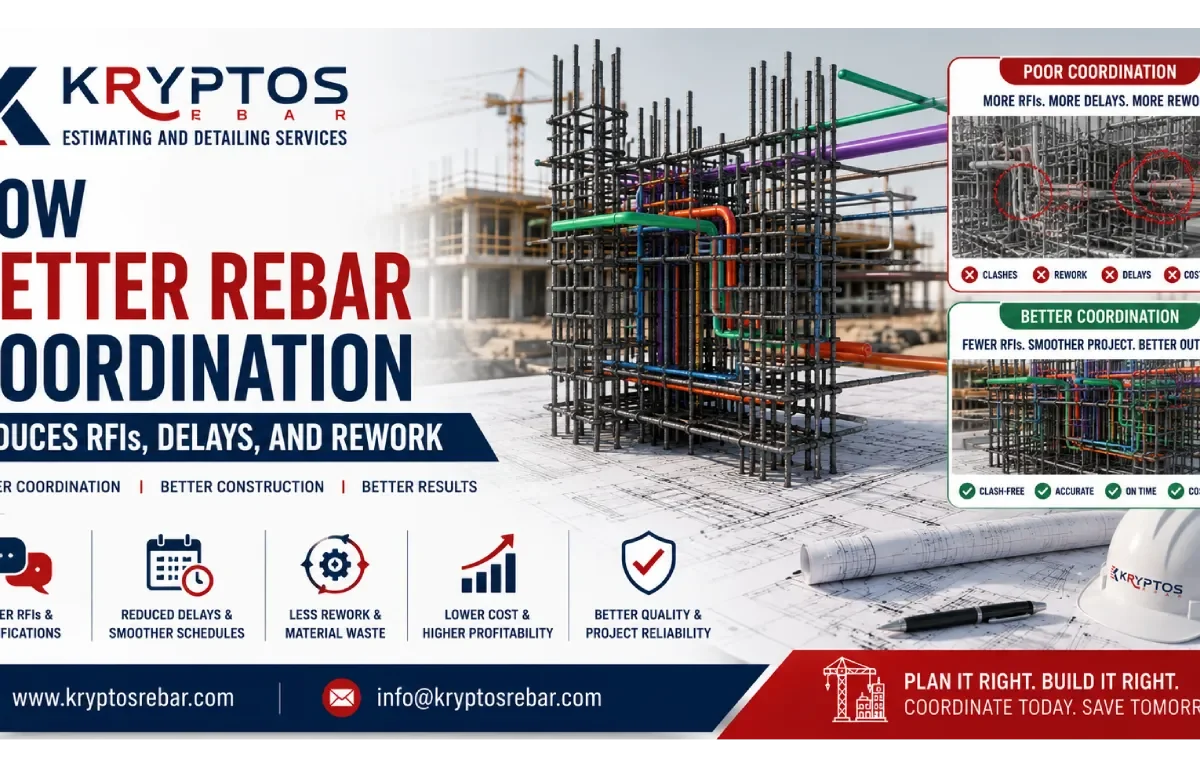




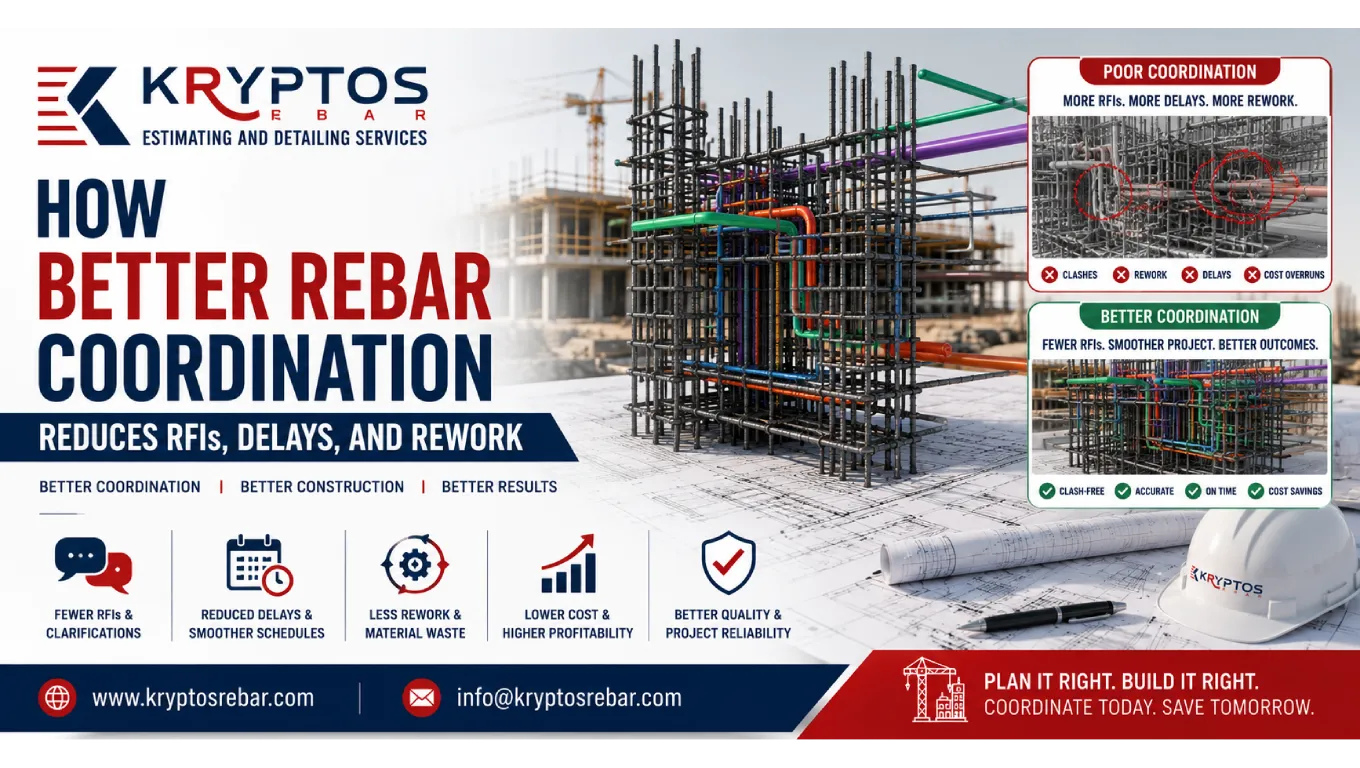
How Better Rebar Coordination Reduces RFIs, Delays, and Rework
A construction project can have accurate structural designs, quality materials, and an experienced site team and still face costly delays because reinforcement was not properly coordinated before fabrication and installation.
This is where rebar coordination becomes critical.
Reinforcement rarely exists in isolation. Rebar must work around concrete geometry, openings, embeds, mechanical and electrical services, formwork, construction joints, couplers, sleeves, and other structural components. When these elements are not coordinated early, problems often appear after fabrication has already started or, worse, when reinforcement reaches the construction site.
The result can be a familiar chain of problems: RFIs, drawing revisions, fabrication changes, material waste, installation delays, rework, and additional project costs.
Better rebar coordination helps identify these issues before they become field problems. By reviewing reinforcement details, structural interfaces, bar placement, dimensions, and constructability early, project teams can make better decisions before steel is cut and bent.
This article explains how effective rebar coordination can reduce RFIs, minimize delays, control rework, and create a smoother path from structural drawings to fabrication and installation.
👉 Rebar Detailing Services
kryptosrebar.com/service/
What Is Rebar Coordination?
Rebar coordination is the process of reviewing and aligning reinforcement information with structural drawings, architectural requirements, MEP services, embeds, openings, construction details, and site conditions before fabrication and installation.
It is more than simply checking whether reinforcement has been detailed correctly.
A proper coordination process asks practical questions:
1.Can the reinforcement actually be fabricated as shown?
2.Can workers place the bars within the available concrete section?
3.Are required concrete covers achievable?
4.Do bars clash with sleeves, embeds, openings, or MEP services?
5.Are beam-column joints constructible?
6.Are laps, couplers, hooks, and anchorage details practical?
7.Do bar sizes and spacing allow sufficient room for concrete placement?
8.Are the drawings consistent across different disciplines?
9.Can the reinforcement be installed in the planned sequence?
These questions connect design intent with real construction conditions.
According to the American Concrete Institute, ACI CODE-318-25 addresses structural concrete design and detailing requirements, including reinforcement development and splicing, construction documents, inspection, and other structural concrete requirements.
For projects using British standards, BS 8666:2020 specifies requirements related to the scheduling, dimensioning, cutting, and bending of steel reinforcement for concrete.
Why Poor Rebar Coordination Creates RFIs
A Request for Information, or RFI, is often a symptom of an unresolved design or coordination issue.
When reinforcement drawings do not clearly address a condition, the contractor or site team may need clarification before proceeding.
Common RFI triggers include:
1. Conflicting Drawings
A structural drawing may show reinforcement passing through an area where an MEP drawing indicates a large sleeve or opening.
Without coordination, the site team must stop and determine which requirement takes priority.
2. Missing Reinforcement Information
Incomplete bar marks, unclear dimensions, missing sections, or inconsistent reinforcement notes can create uncertainty during fabrication or installation.
3. Congested Reinforcement
Highly reinforced zones such as beam-column joints, pile caps, transfer beams, shear walls, and foundation intersections can become difficult to construct.
If congestion is not identified during detailing, the problem may only become obvious during installation.
4. Inconsistent Revisions
A revised structural drawing may change reinforcement while an older shop drawing remains in circulation.
This can lead to questions about which information should be fabricated or installed.
Effective rebar coordination addresses these issues before they reach the field.
How Rebar Coordination Reduces Construction Delays
Construction schedules depend on information arriving at the right time.
A reinforcement issue discovered during fabrication can delay production. A problem discovered after fabrication can delay delivery. A problem discovered during installation can delay an entire concrete pour.
The earlier the problem is identified, the more options the project team has to resolve it.
Coordination Creates an Earlier Decision Point
Consider a congested beam-column connection.
Without a constructability review, the fabricator may produce the reinforcement according to the approved drawing. At the site, workers may discover that several bars cannot be installed as detailed because of overlapping reinforcement, embedded items, or insufficient working space.
The team may then need to:
1.Stop installation.
2.Raise an RFI.
3.Contact the engineering team.
4.Review alternatives.
5.Revise the drawing.
6.Reissue fabrication information.
7.Modify or replace fabricated bars.
8.Reschedule installation.
A coordinated review can identify the same problem before fabrication.
That difference can save days of disruption.
The Connection Between Rebar Coordination and Rework
Rework is expensive because it consumes resources that have already been committed.
When reinforcement needs to be modified after fabrication, the project may incur:
1.Additional labor
2.Cutting and rebending costs
3.Replacement steel
4.Transportation costs
5.Fabrication downtime
6.Site labor inefficiency
7.Concrete pour delays
8.Additional inspection
9.Drawing revision costs
Good rebar detailing reduces the likelihood of these problems by making reinforcement information clearer and more construction-ready.
The goal is not simply to produce drawings that look correct on paper.
The goal is to produce drawings that can be fabricated, delivered, placed, inspected, and built efficiently.
7 Ways Better Rebar Coordination Improves Project Performance
1. Identifies Clashes Before Fabrication
Coordination reviews can identify conflicts between reinforcement and:
1.MEP openings
2.Sleeves
3.Embedded plates
4.Anchor bolts
5.Structural connections
6.Architectural openings
7.Post-installed systems
8Other reinforcement zones
Finding these conflicts digitally or during drawing review is significantly easier than correcting them after fabrication.
2. Improves Rebar Shop Drawings
Construction-ready rebar shop drawings should communicate reinforcement requirements clearly to fabricators and site teams.
A well-coordinated drawing should provide clear information about:
1.Bar marks
2.Bar sizes
3.Bar lengths
4.Spacing
5.Shapes
6.Locations
7.Sections
8.Lap requirements
9.Couplers
10.Hooks and bends
11.Reinforcement layers
12.Concrete cover
13.Construction joints
The objective is to reduce interpretation. When fabrication and site teams receive clear information, fewer clarification requests are necessary.
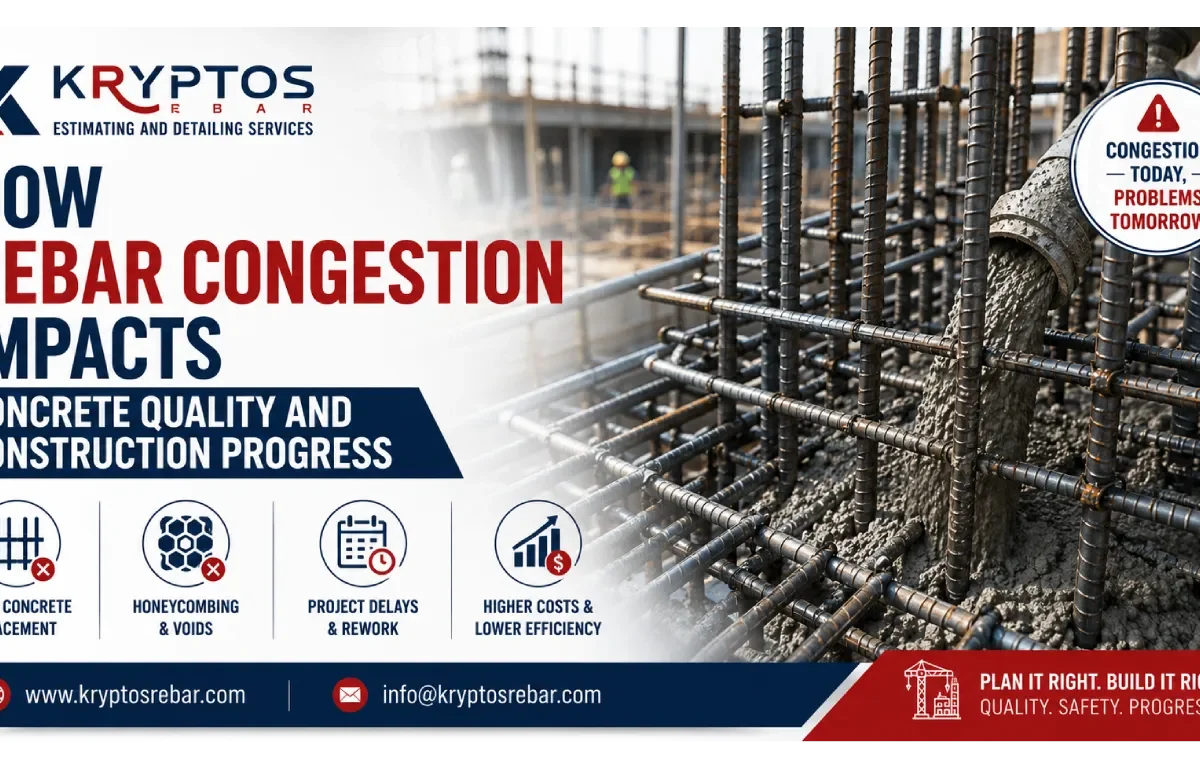
3. Reduces Reinforcement Congestion
Congestion is one of the most important constructability concerns in reinforced concrete construction. A structural member may satisfy design requirements while still presenting installation challenges.
For example, a heavily reinforced beam-column joint may contain:
1.Main longitudinal reinforcement
2.Stirrups
3.Column reinforcement
4.Beam reinforcement
5.Shear reinforcement
6.Couplers
7.Anchorage zones
8.Embedded items
If these elements are not coordinated spatially, installation can become difficult. A constructability-focused review helps identify areas where reinforcement arrangement requires closer attention.
4. Supports Better Concrete Placement
Reinforcement must leave sufficient space for concrete to flow and for proper consolidation. Poorly coordinated reinforcement can create extremely tight spaces between bars. This can make concrete placement and vibration more difficult and may increase the risk of voids or inadequate consolidation. This is why reinforcement coordination should consider not only the steel itself but also the relationship between reinforcement and concrete placement.
5. Improves Fabrication Accuracy
Fabricators depend on reliable information. Incorrect dimensions, inconsistent bar marks, unclear bending requirements, or outdated drawings can result in incorrect fabrication.
A coordinated workflow establishes a stronger connection between:
Design → Detailing → Review → Approval → Fabrication → Delivery → Installation
Each stage should receive consistent information.
6. Supports Better Procurement Planning
Accurate coordination also contributes to quantity control. When reinforcement details change after fabrication or procurement, previously ordered material may no longer match the latest requirement.
This can result in:
1.Excess inventory
2.Material shortages
3.Expedited orders
4.Additional transportation
5.Unplanned purchasing
6.Increased project costs
Coordinated drawings and controlled revisions help project teams maintain better visibility over reinforcement quantities.
7. Improves Overall Project Communication
Construction involves many stakeholders. Structural engineers, detailers, estimators, contractors, fabricators, MEP teams, procurement teams, inspectors, and site supervisors all depend on accurate project information. A coordinated reinforcement package gives these teams a common reference point. That improves communication and reduces the number of decisions that have to be made under site pressure.
Rebar Coordination Should Start Before Fabrication
One of the most important principles is simple:
Do not wait until fabrication to discover constructability problems.
A practical coordination workflow should begin with the latest approved structural information.
Step 1: Review the Latest Drawings
Confirm that the structural drawings, specifications, revisions, and applicable standards are current.
Step 2: Identify High-Risk Areas
Pay special attention to:
1.Beam-column joints
2.Transfer structures
3.Shear walls
4.Pile caps
5.Footings
6.Deep beams
7.Openings
8.Coupler locations
9.Construction joints
10.Heavily reinforced zones
Step 3: Coordinate With Other Disciplines
Compare reinforcement with architectural, MEP, embed, and other relevant drawings.
Step 4: Perform Constructability Review
Check whether the reinforcement can realistically be fabricated and installed within the available geometry.
Step 5: Resolve Conflicts
Raise design questions early and document approved solutions before fabrication.
Step 6: Control Revisions
Make sure the fabrication team and site team are working from the current approved information.
Step 7: Release Construction-Ready Drawings
Only after the relevant coordination and review process should reinforcement information move forward for fabrication.
How Technology Improves Rebar Coordination
Modern detailing workflows can make coordination more efficient by connecting 2D drawings, 3D reinforcement models, quantity information, and revision tracking.
3D modeling can be particularly useful in complex areas because it allows teams to visualize how reinforcement occupies physical space.
Instead of reviewing every conflict mentally from separate 2D views, project teams can examine the reinforcement arrangement spatially.
This can help identify:
1.Bar clashes
2.Layering issues
3.Congested zones
4.Insufficient access
5.Conflicts with embeds
6.Conflicts with openings
7.Difficult bar bending arrangements
Technology does not replace engineering judgment. It supports better decision-making by making potential problems easier to see and discuss.
Standards and Coordination: Why Consistency Matters
Rebar coordination should always follow the project-specific design requirements, specifications, contract documents, and applicable standards.
For U.S.-based structural concrete projects, ACI CODE-318-25 is a key reference covering structural concrete design and detailing requirements. ACI notes that the code includes provisions related to reinforcement, construction documents, and inspection.
For projects following British standards, BS 8666:2020 covers scheduling, dimensioning, cutting, and bending of reinforcement steel and is currently listed by BSI as the current edition.
For projects using Indian standards, IS 1786:2008 covers high-strength deformed steel bars and wires used for concrete reinforcement. The Bureau of Indian Standards identifies IS 1786:2008 as the relevant Indian Standard for this product category.
These standards should not be treated as interchangeable. The applicable standard depends on the project’s location, contract requirements, structural design basis, and specified materials.
A Practical Rebar Coordination Checklist
Before releasing reinforcement information for fabrication, project teams should consider checking:
1.Latest structural drawings are being used
2.Drawing revisions are properly controlled
3.Bar marks are consistent
4.Reinforcement sizes and spacing are verified
5.Bar lengths and shapes are reviewed
6.Concrete cover requirements are addressed
7.Lap and splice locations are coordinated
8.Couplers are coordinated with surrounding reinforcement
9.Beam-column joints are reviewed for congestion
10.Openings and sleeves are coordinated
11.MEP interfaces are reviewed
12.Embedded items are coordinated
13.Reinforcement layers are clearly identified
14.Fabrication requirements are practical
15.Installation sequence has been considered
16.Quantity information matches the latest drawings
17.RFI items are resolved before fabrication
18.Approved revisions are communicated to all relevant teams
This process creates an additional layer of control between structural design and physical construction.
Why Rebar Coordination Is a Business Advantage
It is easy to think of coordination as a technical drawing exercise. In reality, it is also a project management and commercial control activity. Every unresolved clash has the potential to create a downstream cost.
A simple chain illustrates the relationship:
Poor Coordination → Clash → RFI → Revision → Fabrication Change → Site Delay → Rework → Additional Cost
Better coordination aims to interrupt that chain much earlier:
Review → Identify → Coordinate → Resolve → Detail → Fabricate → Install
That is why investing time in coordination before fabrication can have a measurable impact on project performance.
The value is not only in producing better drawings. It is in reducing uncertainty across the entire reinforcement workflow.
How Kryptos Rebar Supports Better Coordination
At Kryptos Rebar, rebar estimating and detailing are approached with construction practicality in mind.
Our workflow focuses on producing reinforcement information that supports estimation, fabrication, coordination, and field execution.
Depending on project requirements, rebar detailing workflows can include:
1.Rebar quantity takeoffs
2.Rebar estimation
3.Rebar shop drawings
4.Bar bending schedules
5.Reinforcement detailing
6.Constructability review
7.Quantity verification
8.Drawing coordination
9.Revision management
10.Fabrication-ready reinforcement documentation
The objective is straightforward: help project teams identify potential reinforcement issues earlier, communicate requirements more clearly, and reduce avoidable problems during fabrication and installation.
For complex projects, early coordination can be especially valuable because even a small drawing conflict can have a larger effect once fabrication and site activities are underway.
Conclusion
Rebar coordination is not simply a drawing review step. It is a proactive construction control process.
When reinforcement is coordinated before fabrication, project teams have a better opportunity to identify clashes, resolve unclear details, manage congestion, improve shop drawings, control quantities, and reduce unnecessary RFIs.
The biggest advantage is timing.
A problem discovered during design coordination can usually be addressed with far less disruption than the same problem discovered after steel has been fabricated or delivered to the site.
Better coordination therefore creates a smoother connection between design intent and construction reality.
For contractors, engineers, fabricators, estimators, and project managers, the message is simple:
Coordinate earlier. Fabricate with confidence. Build with fewer surprises.
Frequently Asked Questions
1. What is rebar coordination?
Rebar coordination is the process of reviewing reinforcement against structural, architectural, MEP, embed, opening, and construction requirements to identify conflicts before fabrication and installation.
2. How does rebar coordination reduce RFIs?
It identifies unclear details, clashes, missing information, and constructability issues before they reach the site. Resolving these issues early can reduce the need for clarification during construction.
3. Why is rebar coordination important before fabrication?
Changes after fabrication can create material waste, additional labor, fabrication delays, and site disruption. Early coordination helps identify problems before steel is cut and bent.
4. Can rebar coordination reduce construction delays?
Yes. Early identification of reinforcement clashes and constructability issues can help prevent fabrication changes, installation interruptions, and delays associated with unresolved RFIs.
5. What areas require the most rebar coordination?
Beam-column joints, transfer beams, pile caps, shear walls, foundations, heavily reinforced zones, openings, couplers, embeds, and areas with significant MEP interfaces typically require closer review.
6. What are rebar shop drawings used for?
Rebar shop drawings provide detailed reinforcement information for fabrication and installation, including bar marks, sizes, lengths, shapes, spacing, locations, sections, and other relevant construction details.
7. How does 3D modeling help with rebar coordination?
3D reinforcement models can make spatial conflicts and congestion easier to visualize. They can help teams identify clashes between reinforcement and other structural or building components before construction.
8. Can rebar coordination help control project costs?
Yes. Better coordination can reduce avoidable rework, material waste, fabrication changes, site delays, and expedited procurement caused by unresolved reinforcement issues.
🚀 Need Accurate Rebar Estimation You Can Trust?
Connect with Kryptos Rebar for precision-driven rebar detailing, estimation, and constructability-focused reinforcement solutions.
📩 Email now: [email protected]
Let’s optimize your structure with precision and confidence.