


Mechanical Rebar Couplers: Applications, Benefits and Detailing Considerations
Reinforced concrete structures depend on the proper connection of reinforcing steel bars to transfer forces safely through structural members. Traditionally, reinforcement bars are connected using lap splices, where two bars overlap for a specified length. However, as construction projects become larger and structural designs require heavier reinforcement, conventional lap splicing can create congestion, increase material usage, and make reinforcement placement more complicated.
Mechanical Rebar Couplers provide an alternative method of connecting reinforcement bars end to end. These connectors are designed to transfer forces between reinforcing bars through a mechanical connection, helping maintain reinforcement continuity without requiring long overlapping bar lengths.
Mechanical couplers are used in various reinforced concrete applications, including high-rise buildings, bridges, foundations, columns, shear walls, and precast structures. Their selection and detailing require careful consideration of structural design requirements, reinforcement dimensions, installation methods, and applicable standards.
This guide explains the applications, benefits, types, and important detailing considerations of mechanical rebar couplers and how accurate reinforcement documentation supports successful construction.
👉 Rebar Detailing Services
kryptosrebar.com/service/
What Are Mechanical Rebar Couplers?
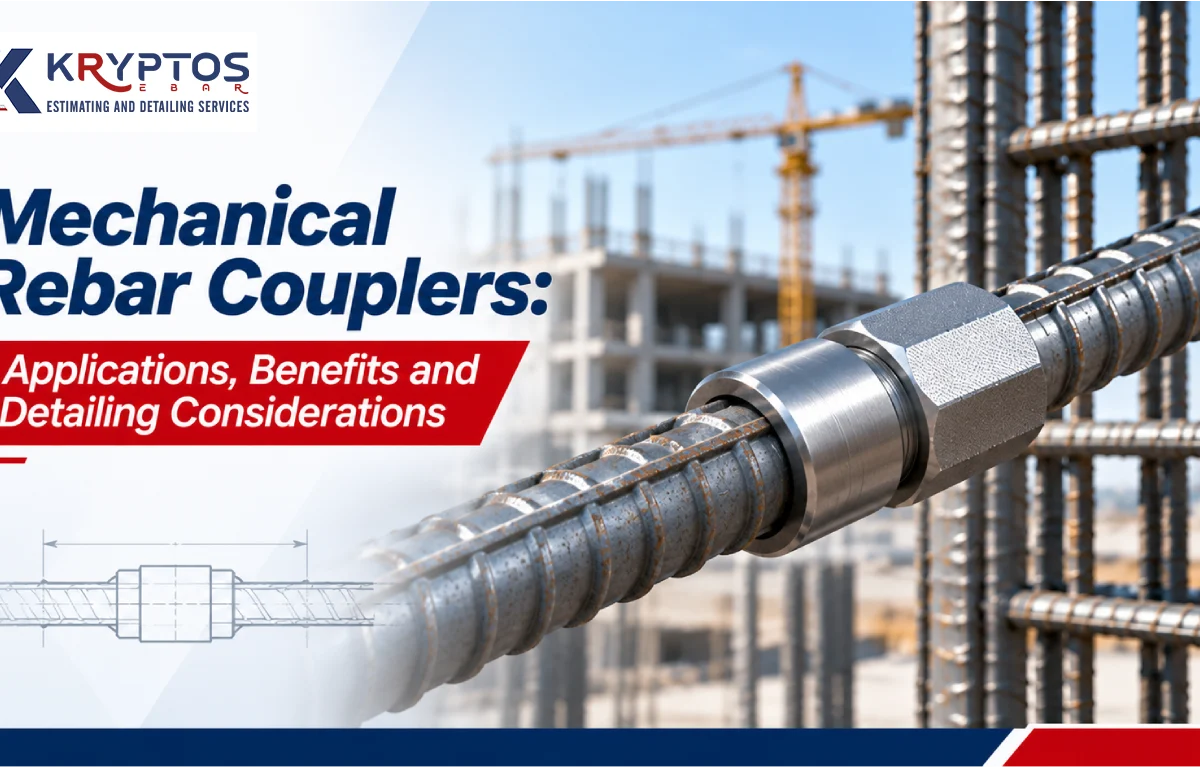
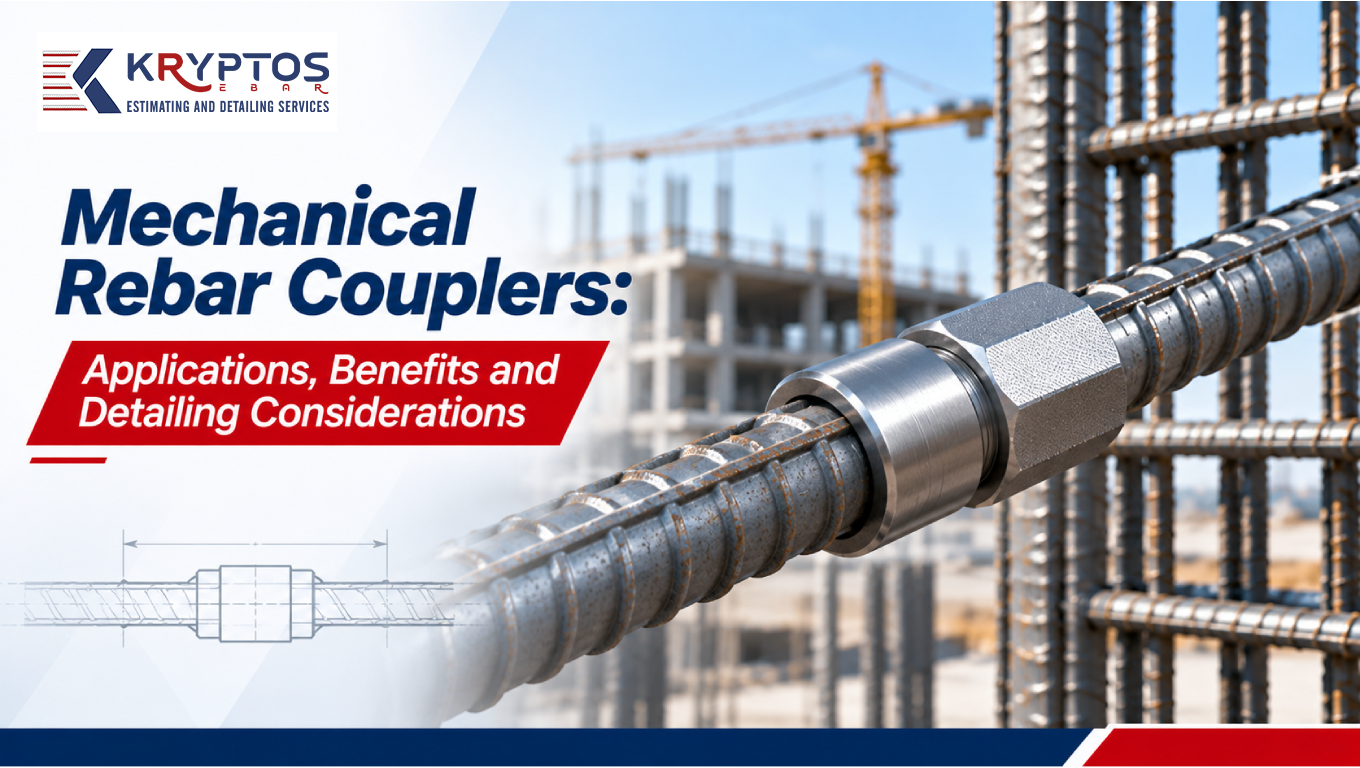
Mechanical Rebar Couplers are specially designed connectors used to join two reinforcing steel bars. They create a mechanical connection that transfers forces from one reinforcement bar to another without relying on a conventional overlapping arrangement.
A typical coupler consists of a metal sleeve or threaded connector that joins the ends of two reinforcement bars. Depending on the coupler system, the connection may use threaded ends, locking screws, swaging, or grout-based mechanisms.
The primary purpose is to provide the required mechanical connection while maintaining the performance specified by the structural engineer. The coupler must be suitable for the reinforcement grade, bar diameter, loading conditions, and project requirements.
Unlike ordinary lap splices, mechanical connections can reduce the amount of reinforcement occupying a particular structural zone. This can be particularly useful in heavily reinforced columns, walls, foundations, and other areas where multiple bars are positioned close together.
The selection of a suitable coupler should always be based on approved technical documentation, required splice performance, and the applicable structural design standards.
Why Are Mechanical Rebar Couplers Used in Construction?
Mechanical couplers are commonly considered when conventional reinforcement splicing becomes difficult or inefficient. In structures containing large-diameter reinforcement bars, the required lap length can occupy considerable space. When several bars need to be connected within the same structural region, overlapping arrangements may increase reinforcement congestion.
Mechanical couplers provide a more compact connection arrangement because the bars are joined through a connector rather than an extended lap.
They can also support construction planning by allowing reinforcement to be prepared in manageable lengths. This is useful in projects where reinforcement must be transported, lifted, positioned, or installed in stages.
Another important application is construction joints. Couplers can be incorporated into the first concrete pour so that reinforcement from the next construction stage can be connected without leaving long projecting bars in the work area.
The final selection depends on the structural requirements, construction sequence, accessibility, and approved coupler system.
1. Rebar Coupler Types: Understanding Different Connection Systems
Rebar Coupler Types vary according to their connection mechanism, reinforcement preparation requirements, and installation process. Choosing the correct type is important because different systems are designed for different site conditions and structural applications.
Threaded couplers connect reinforcing bars through matching external threads and internal threads within the connector. Some systems use upset bar ends, where the ends are enlarged before threading to maintain the required connection capacity. Other systems use threads cut directly into the reinforcement, subject to the manufacturer’s specifications and approval requirements.
Parallel-thread couplers use straight threads to connect reinforcement bars. They are commonly selected where a consistent threaded connection is required. Depending on the product design, the bars may need to be prepared using specific threading equipment.
Taper-thread couplers use tapered threads that tighten as the reinforcement bar is rotated into the connector. These systems are designed to provide a secure mechanical connection when installed according to the manufacturer’s instructions.
Grouted sleeve couplers connect reinforcement bars through a sleeve containing specially specified grout. The reinforcement ends are inserted into the sleeve, and the grout transfers forces between the bars and the connector after the required curing process.
Lock-shear bolt couplers use tightening screws or bolts that engage with the reinforcement bars. Some systems are designed so that the screw heads shear off at a specified installation torque, providing a visual indication of tightening.
The appropriate coupler type should be selected based on the required connection performance, bar size, accessibility, installation equipment, and project specifications. Not all coupler systems are interchangeable, and their suitability must be established through approved technical documentation.
2. Mechanical Rebar Splicing: Applications in Reinforced Concrete Structures
Mechanical Rebar Splicing is used in different structural components where reinforcement continuity and efficient construction arrangements are important. Its application depends on the structural engineer’s design and the connection performance required for the specific location.
In high-rise buildings, couplers may be used in reinforced concrete columns and shear walls. These structural elements often contain multiple reinforcement bars extending across different construction levels. Mechanical connections can help organize reinforcement between successive concrete pours while reducing the need for long lap lengths.
In foundation construction, couplers can connect reinforcement in pile caps, raft foundations, retaining structures, and heavily reinforced foundation elements. They are particularly useful where reinforcement congestion makes conventional overlapping arrangements difficult to accommodate.
Bridge construction is another important application. Reinforced concrete bridge piers, abutments, and other structural components may require reinforcement connections at designated construction joints. Approved coupler systems can support these connections while accommodating the construction sequence.
Precast concrete construction also benefits from mechanical connections. Reinforcement can be prepared in advance, and couplers can provide designated connection points between precast elements or between precast and cast-in-place components.
Other applications include:
1.Reinforced concrete columns and beams.
2.Shear walls and retaining walls.
3.Industrial foundations and equipment supports.
4.Transfer structures and heavily reinforced structural members.
The coupler arrangement must always match the approved structural drawings and project specifications.
3. Rebar Coupler Installation: Important Construction Considerations
Rebar Coupler Installation requires proper preparation, alignment, and assembly. Even a technically suitable connector may not perform as intended if the installation process does not follow the manufacturer’s instructions.
Before installation, the reinforcement bars should be checked for the correct diameter, grade, identification, and end preparation. Threaded systems require the specified thread profile and dimensions. Grouted systems require the correct sleeve preparation, bar insertion, grout material, and installation procedure.
Alignment is another important consideration. Reinforcement bars should be positioned so that they connect correctly without creating unintended bending or misalignment at the joint. The coupler should also be installed using the specified tools and tightening procedure.
For threaded and lock-shear bolt systems, the required tightening method must be followed. For grout-filled systems, the specified grout should be prepared and placed according to the approved installation procedure, including any required curing period.
Site teams should also verify that couplers are protected from contamination, damage, and unwanted movement before concrete placement.
A proper installation process should include checking product identification, bar preparation, connector engagement, alignment, tightening or grouting requirements, and inspection records. Any installation that does not meet the approved requirements should be referred to the responsible project team for resolution.
4. Rebar Coupler Detailing: Essential Drawing Requirements
Rebar Coupler Detailing is an important part of reinforcement documentation because it communicates the exact location and arrangement of mechanical connections. Accurate detailing helps fabricators, contractors, and site teams understand how the couplers should be incorporated into the reinforcement layout.
The detailer should first review the structural drawings to identify the specified coupler locations, reinforcement sizes, connection requirements, and relevant construction joints. The selected coupler system should be checked against the approved product information before preparing the final detailing documents.
Coupler locations must be shown clearly in reinforcement elevations, sections, and relevant enlarged details. The drawings should identify the bar marks, reinforcement diameters, connector references, and any special installation requirements needed by the construction team.
One important consideration is the physical size of the coupler. Mechanical connectors usually have a larger external dimension than the reinforcement bar itself. This additional dimension can affect the available space between adjacent bars, concrete cover, and surrounding reinforcement.
The detailer should therefore review the coupler arrangement for possible congestion, particularly in columns, beam-column joints, shear walls, and foundation reinforcement zones. If the couplers create a clearance problem or conflict with other reinforcement, the issue should be documented and referred to the structural engineer.
A well-prepared coupler detailing package should maintain consistency between reinforcement drawings, bar bending schedules, coupler schedules, and installation information. This helps reduce confusion during fabrication and site execution.
5. Major Benefits of Mechanical Rebar Couplers
Mechanical couplers offer several construction and detailing advantages when they are selected and installed correctly.
One of the main benefits is reduced reinforcement congestion. Lap splices require overlapping bars, which can create crowded reinforcement arrangements in heavily reinforced structural members. Mechanical connections can reduce this overlap and create more space for concrete placement and consolidation.
Another advantage is the efficient use of reinforcement lengths. Since the bars are connected through a mechanical connector, the project may avoid some of the additional bar length associated with conventional lap arrangements. The actual material and cost benefits depend on bar sizes, coupler prices, installation requirements, and the overall design.
Mechanical couplers can also support construction sequencing. They allow reinforcement to be connected at planned stages, which can be useful for vertical construction, precast components, and construction joints.
From a detailing perspective, couplers can provide greater flexibility in arranging reinforcement where long lap lengths are difficult to accommodate. They may also simplify certain reinforcement layouts and make individual bars easier to handle.
However, couplers should not be assumed to be automatically faster, cheaper, or better for every project. Their overall value depends on the selected system, labour availability, equipment, inspection requirements, and structural design.
6. Quality Control and Inspection of Mechanical Couplers
Quality control is essential to confirm that the mechanical connection meets the requirements specified for the project. The inspection process should cover both the coupler product and the completed installation.
The project team should verify that the coupler model is approved for the intended application and that its technical documentation matches the specified reinforcement size and grade. Required test reports, certifications, product approvals, and installation instructions should be available for review.
During installation, inspectors should check bar preparation, thread engagement where applicable, connector positioning, tightening requirements, and grout placement for systems that use grout. The inspection method should follow the project specifications and the manufacturer’s approved procedure.
Mechanical splice testing may also be required. Depending on the applicable code and project requirements, testing can evaluate tensile strength, slip, cyclic performance, or other specified properties. The required testing frequency and acceptance criteria should be established by the responsible design and quality teams.
For reliable documentation, inspection results and any non-conformance issues should be recorded and resolved before the affected work proceeds.
Common Challenges in Mechanical Rebar Coupler Detailing
Although mechanical couplers provide several advantages, their use can introduce detailing and installation challenges when project requirements are not coordinated properly.
One common issue is coupler congestion. The external diameter of a connector may be significantly larger than the bar diameter, reducing the available space between neighbouring reinforcement bars. This can affect concrete flow and may make vibrator access difficult.
Another challenge is incorrect coupler positioning. If the connector is shown at an unsuitable location or does not match the construction sequence, site teams may find it difficult to connect the reinforcement as intended.
Bar preparation can also create difficulties. Threaded systems may require specific cutting, upsetting, or threading processes, while grouted systems require careful control of sleeve preparation and grout placement.
Changes in reinforcement sizes or structural design revisions may also affect previously detailed coupler arrangements. Therefore, coupler schedules and reinforcement drawings must be updated together whenever an approved change is issued.
These challenges can be managed through early coordination, correct product selection, accurate drawings, and a structured inspection process.
How Professional Rebar Detailing Supports Coupler-Based Construction
Mechanical couplers require coordination between structural design, reinforcement detailing, fabrication, and site installation. A clear detailing package helps communicate the approved connection arrangement and reduces the possibility of misunderstandings during construction.
Professional rebar detailing services can support this process through reinforcement shop drawings, coupler location details, bar bending schedules, reinforcement quantity calculations, and drawing revision management.
At Kryptos Rebar, project teams can explore rebar detailing and estimation support for reinforced concrete construction. Accurate reinforcement documentation can help organize bar information, coordinate connection locations, and support fabrication and installation planning.
For additional technical information, consult the Concrete Reinforcing Steel Institute (CRSI) for an overview of reinforcing bar splicing methods and mechanical coupler systems.
For international requirements, the ISO 15835-1 standard provides requirements for couplers used in mechanical splices of reinforcing bars. In India, refer to Bureau of Indian Standards (BIS) for information on IS 16172:2023, covering reinforcement couplers for mechanical splices of steel bars in concrete.
The applicable standard and acceptance requirements should be confirmed for each project. Product selection, connection design, and approval remain subject to the responsible structural engineer and relevant project authorities.
Conclusion
Mechanical Rebar Couplers provide an effective connection option for reinforced concrete structures where reinforcement continuity, limited lap space, and construction coordination are important. They are used in high-rise buildings, foundations, bridges, shear walls, columns, and precast concrete applications.
Their benefits include reduced reinforcement congestion, more efficient use of bar lengths in suitable applications, and improved flexibility in construction sequencing. However, these advantages depend on choosing an approved coupler system and following the specified design, detailing, installation, and inspection requirements.
Accurate rebar coupler detailing plays an important role in communicating connection locations, maintaining reinforcement clearances, and coordinating couplers with the overall reinforcement arrangement. With proper documentation and quality control, mechanical couplers can support organized and efficient reinforced concrete construction.
Frequently Asked Questions
1. What are mechanical rebar couplers used for?
Mechanical rebar couplers are used to connect two reinforcing steel bars end to end. They transfer forces between the bars and can provide an alternative to conventional lap splices in suitable structural applications.
2. What are the common types of mechanical rebar couplers?
Common types include parallel-thread couplers, taper-thread couplers, grouted sleeve couplers, and lock-shear bolt couplers. The appropriate type depends on the bar specifications, required connection performance, and installation conditions.
3. Are mechanical rebar couplers better than lap splices?
Mechanical couplers can be advantageous where reinforcement congestion, large bar diameters, or limited lap space create construction difficulties. However, lap splices may remain suitable and economical for many applications. The correct method depends on structural design and project requirements.
4. Why is mechanical rebar coupler detailing important?
Mechanical rebar coupler detailing identifies connector locations, reinforcement sizes, bar marks, and installation requirements. Accurate drawings help prevent coordination issues and support correct fabrication and installation.
5. Which standards apply to mechanical rebar couplers?
Applicable requirements depend on the project location and structural design. References may include ACI 318 provisions, ISO 15835, and India’s IS 16172. The project specifications and relevant authority requirements should determine the standards used.
🚀 Need Accurate Rebar Estimation You Can Trust?
Connect with Kryptos Rebar for precision-driven rebar detailing, estimation, and constructability-focused reinforcement solutions.
📩 Email now: [email protected]
Let’s optimize your structure with precision and confidence.