



Advanced Shear Wall Reinforcement Detailing for Structural Stability
In high-rise buildings, structural safety is primarily governed by how effectively the structure resists lateral forces such as wind and earthquakes. One of the most critical elements used for this purpose is the shear wall. Proper shear wall reinforcement detailing ensures that these vertical structural elements perform efficiently under extreme loading conditions.
Shear walls not only provide strength but also contribute to stiffness, ductility, and energy dissipation. Without proper detailing, even a well-designed structure can fail under seismic or wind loads.
To understand how detailing impacts real-world execution, refer to our internal guide:
👉 Rebar Detailing Services
https://kryptosrebar.com/service/
Boundary Elements in Shear Walls
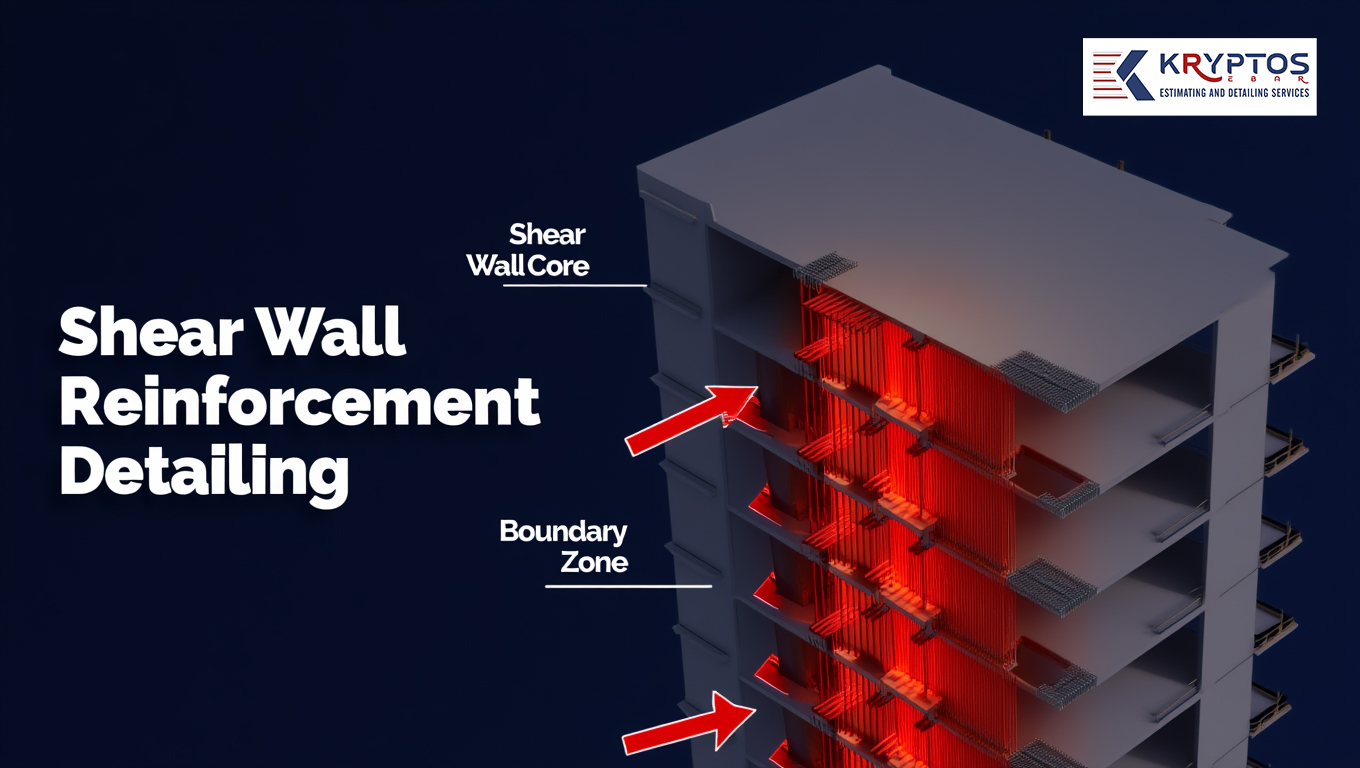
Boundary elements are heavily reinforced zones located at the edges of shear walls. These elements are crucial for handling high compressive and tensile stresses generated during lateral loading.
Functions of boundary elements:
1.Improve load-carrying capacity
2.Enhance ductility
3.Prevent premature failure
Improper detailing of boundary elements can lead to:
1.Crushing of concrete
2.Loss of structural stability
3.Reduced seismic performance
According to
👉 ACI 318 Structural Concrete Code
https://www.concrete.org/store/productdetail.aspx?ItemID=318 boundary elements must be designed with proper confinement reinforcement to ensure safety under extreme loads.
Coupling Beam Reinforcement
Coupling beams connect adjacent shear walls and play a vital role in transferring forces between them. These beams are subjected to high shear and bending stresses, making their reinforcement detailing critical.
Key considerations:
1.Provide diagonal reinforcement for high shear resistance
2.Ensure proper anchorage into shear walls
3.Maintain adequate confinement
Poor coupling beam detailing can result in:
1.Brittle failure
2.Reduced energy dissipation capacity
3.Structural imbalance
Proper reinforcement ensures that coupling beams behave in a ductile manner during seismic events.
Seismic Detailing Requirements
Shear walls must be detailed according to seismic design principles to withstand earthquake forces. Seismic detailing focuses on ductility, allowing the structure to absorb and dissipate energy without collapsing.
Important seismic detailing requirements:
1.Close spacing of ties in critical regions
2.Strong confinement reinforcement
3.Proper lap placement in low-stress zones
4.Adequate development length
For global standards, refer to
👉 Eurocode 8 Seismic Design Guidelines
https://eurocodes.jrc.ec.europa.eu/showpage.php?id=138
Ignoring seismic detailing can lead to catastrophic failures during earthquakes, even if the structure meets basic strength requirements.
Shear Wall Design Principles
Shear wall reinforcement detailing must align with overall structural design principles. Engineers must consider:
1.Load paths and force distribution
2.Interaction between walls and slabs
3.Wall thickness and aspect ratio
4.Openings and discontinuities
Effective detailing ensures:
1..Uniform stress distribution
2.Reduced cracking
3.Improved structural performance
Professional detailing services like Kryptos Rebar ensure that all reinforcement components are accurately designed and coordinated for efficient execution.
Common Detailing Challenges
In real-world projects, several challenges arise in shear wall reinforcement detailing:
1.Reinforcement congestion in boundary zones
2.Improper spacing affecting concrete flow
3.Poor anchorage leading to weak connections
4.Lack of coordination between design and site teams
These issues can compromise both safety and constructability.
Best Practices for Shear Wall Detailing
To ensure effective detailing:
1.Maintain uniform reinforcement spacing
2.Provide adequate confinement reinforcement
3.Ensure proper anchorage and development length
4.Follow seismic detailing codes strictly
5.Use experienced detailing professionals
These practices improve both structural performance and site execution efficiency.
Structural Behavior Insight
Shear walls behave differently compared to other structural elements. Under lateral loads, they must:
1.Resist bending and shear simultaneously
2.Provide stiffness to control displacement
3.Exhibit ductility to absorb seismic energy
This makes reinforcement detailing even more critical. The goal is not just strength—but controlled flexibility and energy dissipation.
Conclusion
Shear wall reinforcement detailing is essential for ensuring stability in high-rise structures. Proper detailing of boundary elements, coupling beams, and seismic reinforcement plays a crucial role in maintaining structural integrity under extreme loading conditions.
By following design standards, addressing practical challenges, and implementing best practices, engineers can create safe, durable, and high-performing structures.
Need rebar design & estimation for your project?
Get accurate, cost-efficient, and site-ready solutions from Kryptos Rebar.
📩 Email now: [email protected]
Let’s optimize your structure with precision and confidence.