



How Rebar Congestion Impacts Concrete Quality and Construction Progress
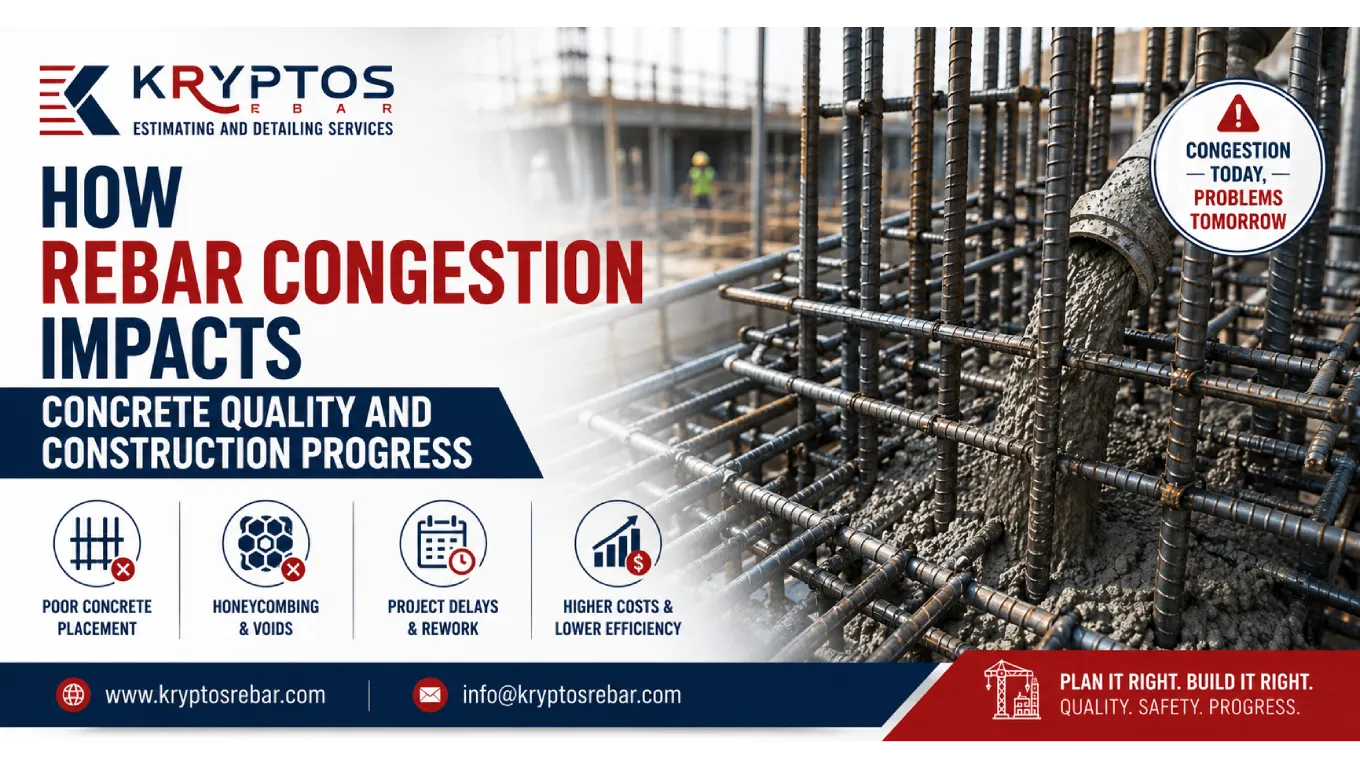
Rebar Congestion is a common challenge in reinforced concrete construction, particularly in heavily loaded structural zones. When too many reinforcement bars occupy a limited space, placing and compacting concrete becomes more difficult. If the condition is not identified early, it can affect concrete quality, reinforcement placement, fabrication, site productivity, and project schedules.
Modern structures often require substantial reinforcement around beam-column joints, transfer beams, shear walls, core walls, pile caps, foundations, and other high-stress areas. While reinforcement is essential for structural performance, excessive concentration of bars can create practical challenges for construction teams.
The issue is therefore not simply the amount of reinforcement being used. It is also about how that reinforcement is arranged within the available concrete space.
Effective rebar detailing, coordination, constructability reviews, and early communication between engineers, detailers, fabricators, and contractors can help identify congestion before reinforcement reaches the site.
This article explains what causes rebar congestion, how it affects concrete quality and construction progress, and what project teams can do to reduce its impact.
👉 Rebar Detailing Services
kryptosrebar.com/service/
What Is Rebar Congestion?
Rebar congestion occurs when reinforcement bars become so densely arranged within a concrete member or connection that there is insufficient practical space for proper placement, concrete flow, vibration, or construction access.
Congestion can occur in:
1.Beam-column joints
2.Transfer beams
3.Shear walls
4.Core walls
5.Footings
6.Pile caps
7.Deep beams
8.Slab-column connections
9.Coupling beams
10.Structural openings
11.Heavily reinforced columns
Congestion does not necessarily mean that the structural design is incorrect. A highly reinforced area may be required because of structural loads, seismic requirements, anchorage, development lengths, or other engineering considerations.
The challenge is making sure the reinforcement can be fabricated, transported, placed, and concreted properly.
This is where constructability-focused detailing becomes important.
Why Rebar Congestion Occurs
Several factors can contribute to reinforcement congestion.
High Reinforcement Demand
Structural members carrying significant loads may require large quantities of reinforcement.
When multiple reinforcement requirements converge within a relatively small section, available space can become limited.
Beam-Column Connections
Beam-column joints are particularly vulnerable to congestion because longitudinal bars, stirrups, column reinforcement, and beam reinforcement may all intersect within the same region.
Lap Splices
Improperly coordinated lap locations can create large concentrations of reinforcement.
If multiple bars are lapped at the same location, the resulting steel density can make concrete placement more difficult.
Development and Anchorage Requirements
Bars require sufficient development and anchorage according to the applicable structural design requirements. These requirements can result in longer bars extending into already congested areas.
Multiple Structural Elements Intersecting
Where beams, columns, walls, slabs, and transfer structures meet, reinforcement from several elements may occupy the same physical space.
Late Design Changes
Design revisions introduced after detailing or procurement can increase reinforcement density without sufficient time for comprehensive coordination.
7 Major Impacts of Rebar Congestion
1. Difficult Concrete Placement
One of the most immediate effects of rebar congestion is restricted concrete flow.
Concrete needs to move around reinforcement and fill the available formwork completely. When reinforcement is extremely dense, concrete may struggle to pass through narrow spaces.
This becomes particularly challenging around:
1.Beam-column joints
2.Dense wall reinforcement
3.Column cages
4.Transfer structures
5.Embedded items
If concrete cannot flow properly, construction teams may need to adjust placement methods or sequencing.
A constructability review before fabrication can identify areas where reinforcement arrangement may create practical placement challenges.
2. Poor Concrete Compaction
Concrete must be properly consolidated to reduce voids and ensure the intended material properties are achieved.
Dense reinforcement can restrict access for internal vibrators and make adequate consolidation more difficult.
Poor consolidation can contribute to:
1.Voids
2.Honeycombing
3.Entrapped air
4.Incomplete filling
5.Surface defects
The exact risk depends on the concrete mixture, member geometry, reinforcement arrangement, placement method, and site practices.
This is why reinforcement detailing should consider not only structural requirements but also practical concrete placement.
3. Increased Risk of Honeycombing
Honeycombing refers to areas where concrete does not properly fill the formwork, leaving visible voids or exposed aggregate.
Rebar congestion can contribute to this problem when reinforcement restricts concrete movement or prevents adequate consolidation.
However, honeycombing is not caused by reinforcement alone. Other factors include:
1.Poor vibration
2.Inappropriate concrete placement
3.Formwork problems
4.Concrete workability
5.Incorrect construction practices
A coordinated construction approach is therefore essential.
4. Slower Construction Progress
Rebar congestion can increase installation time.
Workers may need additional time to position bars, secure reinforcement, install couplers, maintain cover, and work around congested zones.
This can affect subsequent activities such as:
1.Formwork closure
2.Inspection
3.Concrete placement
4.Concrete finishing
5.Stripping
6.Follow-on trades
When congestion repeatedly occurs across a project, the accumulated impact can become significant.
Early detailing coordination helps reduce these avoidable delays.
5. Difficult Reinforcement Installation
A reinforcement arrangement may satisfy the design requirements but still be difficult to install.
Workers need sufficient access to place and tie reinforcement correctly.
Congested reinforcement can make it difficult to:
1.Insert bars
2.Tie intersections
3.Maintain spacing
4.Maintain cover
5.Install couplers
6.Position spacers
7.Complete inspections
This is why rebar constructability should be considered during the detailing stage rather than discovered during installation.
6. Increased RFI and Rework Risk
When site teams encounter reinforcement that does not fit as expected, they may raise Requests for Information (RFIs).
The resulting process may involve:
1.Site identifies the issue.
2.Contractor raises an RFI.
3.Engineering team reviews the condition.
4.Revised reinforcement information is prepared.
5.Approval is obtained.
6.Fabrication or site work is adjusted.
Every additional step can affect productivity and schedule certainty.
A detailed constructability review can move much of this problem-solving process upstream.
7. Higher Project Costs
Rebar congestion can increase costs indirectly through:
1.Additional labor
2.Fabrication changes
3.Material waste
4.Rework
5.Engineering revisions
6.Site delays
7.Extended equipment usage
8.Schedule disruption
The cost impact is not always visible in the original reinforcement quantity.
A project may have an accurate tonnage estimate while still experiencing higher construction costs because the reinforcement arrangement is difficult to execute.
This distinction is important: quantity accuracy and constructability are related, but they are not the same thing.
How Rebar Detailing Helps Control Congestion
Professional rebar detailing provides an opportunity to identify congestion before fabrication.
Detailers can examine reinforcement arrangements and identify areas where multiple bars overlap or compete for limited space.
A thorough detailing process can review:
1.Bar spacing
2.Bar layering
3.Lap locations
4.Coupler locations
5.Bar diameters
6.Reinforcement intersections
7.Concrete cover
8.Openings
9.Embedded items
10.Construction sequence
The objective is not to remove reinforcement simply to reduce congestion.
Any structural change must be reviewed and approved by the responsible engineer.
Instead, the objective is to communicate potential constructability problems clearly and support the engineering team in finding an approved solution.
The Importance of a Rebar Constructability Review
A constructability review should be performed before reinforcement fabrication, particularly for complex or highly reinforced areas.
The review should ask practical questions such as:
1.Can the reinforcement be physically installed?
2.Can workers access the required tying locations?
3.Can concrete flow around the reinforcement?
4.Can vibration equipment reach the required areas?
5.Are lap splices concentrated unnecessarily?
6.Are openings coordinated?
7.Are couplers positioned appropriately?
8.Does the reinforcement arrangement maintain required cover?
These questions connect engineering drawings with actual site conditions.
Using BIM to Identify Rebar Congestion
BIM and 3D reinforcement modeling can significantly improve congestion analysis.
Instead of examining reinforcement only through individual 2D drawings, project teams can view the relationship between:
1.Beams
2.Columns
3.Slabs
4.Walls
5.Reinforcement
6.MEP elements
7.Openings
8.Embedded components
This makes complex intersections easier to understand.
BIM-based coordination can also support clash detection and improve communication between disciplines.
For projects using openBIM workflows, buildingSMART provides standards and resources designed to support interoperability and information exchange across the built environment. buildingSMART International – openBIM
Practical Ways to Reduce Rebar Congestion
Reducing congestion should always be based on approved engineering solutions. Some practical approaches include:
Optimize Reinforcement Arrangement
Where permitted by the structural design, reinforcement can be arranged more efficiently to improve constructability.
Review Lap Locations
Avoid unnecessarily concentrating multiple lap splices in the same area.
Consider Mechanical Couplers
Where appropriate and approved, mechanical couplers can help manage reinforcement continuity and reduce congestion.
Coordinate Openings Early
MEP sleeves and structural openings should be coordinated before reinforcement fabrication.
Use Clear Section Details
Complex reinforcement zones should have sufficient sectional views and enlarged details.
Review Critical Zones First
Prioritize beam-column joints, transfer structures, core walls, and other highly reinforced areas.
Coordinate With the Construction Team
Site feedback can reveal practical installation constraints that may not be obvious from drawings alone
Rebar Congestion and Concrete Quality: The Connection
The relationship between reinforcement and concrete quality is particularly important.
Reinforcement must be arranged so that concrete can adequately surround the bars and the required cover can be maintained.
When reinforcement becomes excessively dense, the risk of placement and consolidation difficulties increases.
This means successful reinforced concrete construction requires coordination between:
Structural design + Rebar detailing + Fabrication + Site installation + Concrete placement
None of these activities should be considered independently.
The reinforcement design may be structurally appropriate, but successful construction requires the entire system to work together.
A Simple Workflow for Managing Rebar Congestion
A practical project workflow can follow these steps:
Step 1: Identify High-Risk Areas
Mark heavily reinforced zones during design review.
Step 2: Develop Detailed Reinforcement Models
Create coordinated reinforcement drawings or 3D models.
Step 3: Perform Congestion Checks
Review bar intersections, spacing, laps, and access.
Step 4: Coordinate Other Disciplines
Check reinforcement against MEP, architectural, and embedded components.
Step 5: Conduct Constructability Review
Evaluate fabrication and installation practicality.
Step 6: Resolve Issues Before Fabrication
Send design-related concerns to the responsible engineering team for approval.
Step 7: Issue Approved Fabrication Information
Only approved and coordinated drawings should be released for production.
Step 8: Monitor Site Installation
Use field feedback to improve future detailing and coordination.
Common Mistakes to Avoid
Project teams should avoid these common approaches:
1.Waiting until site installation to identify congestion
2.Ignoring highly reinforced connection zones
3.Reviewing only reinforcement quantities
4.Failing to coordinate MEP openings
5.Using outdated drawings
6.Concentrating lap splices unnecessarily
7.Making field changes without engineering approval
8.Treating constructability as only a fabrication issue
The earlier congestion is identified, the easier it generally is to coordinate a practical solution.
How Kryptos Rebar Helps Manage Rebar Congestion
At Kryptos Rebar, reinforcement detailing is approached with both engineering coordination and construction practicality in mind.
Our services can support project teams through:
1.Rebar detailing
2.Rebar estimation
3.3D reinforcement modeling
4.Constructability reviews
5.Reinforcement coordination
6.Quantity verification
7.Shop drawing preparation
8.Bar Bending Schedule preparation
Our workflow is designed to help identify potential reinforcement issues before they reach fabrication or site installation.
For complex projects, early review of congested zones can help reduce RFIs, rework, fabrication changes, and construction interruptions.
Conclusion
Rebar Congestion is more than a detailing challenge. When reinforcement becomes too dense for practical installation and concrete placement, it can affect concrete quality, site productivity, fabrication, cost, and project schedules.
The most effective approach is to identify congestion early.
Accurate rebar detailing, 3D coordination, constructability reviews, disciplined revision management, and communication between engineering and construction teams can help prevent many congestion-related problems before fabrication begins.
The goal is not simply to use less reinforcement. The goal is to create reinforcement arrangements that satisfy the approved structural requirements while remaining practical to fabricate, install, inspect, and surround with concrete.
For complex reinforced concrete projects, early attention to rebar congestion can make the difference between a smooth construction sequence and expensive site-level problem solving.
Frequently Asked Questions
1. What is rebar congestion?
Rebar congestion occurs when reinforcement bars are densely packed within a structural element, leaving limited practical space for bar placement, concrete flow, vibration, and construction access.
2. Where does rebar congestion commonly occur?
It commonly occurs at beam-column joints, transfer beams, core walls, shear walls, pile caps, footings, coupling beams, and heavily reinforced columns.
3. Can rebar congestion affect concrete quality?
Yes. Excessive reinforcement density can make concrete placement and consolidation more difficult, potentially increasing the risk of voids, honeycombing, and incomplete filling if appropriate placement and consolidation cannot be achieved.
4. How can rebar congestion be reduced?
Potential approaches include optimizing approved reinforcement arrangements, reviewing lap locations, coordinating openings early, considering approved mechanical couplers, improving detailing, and performing constructability reviews before fabrication.
5. How does BIM help with rebar congestion?
BIM and 3D reinforcement modeling allow project teams to visualize complex reinforcement arrangements, identify clashes, review congested zones, and coordinate reinforcement with other building elements before fabrication.
🚀 Need Accurate Rebar Estimation You Can Trust?
Connect with Kryptos Rebar for precision-driven rebar detailing, estimation, and constructability-focused reinforcement solutions.
📩 Email now: [email protected]
Let’s optimize your structure with precision and confidence.